

by Cathy M. Rosenthal
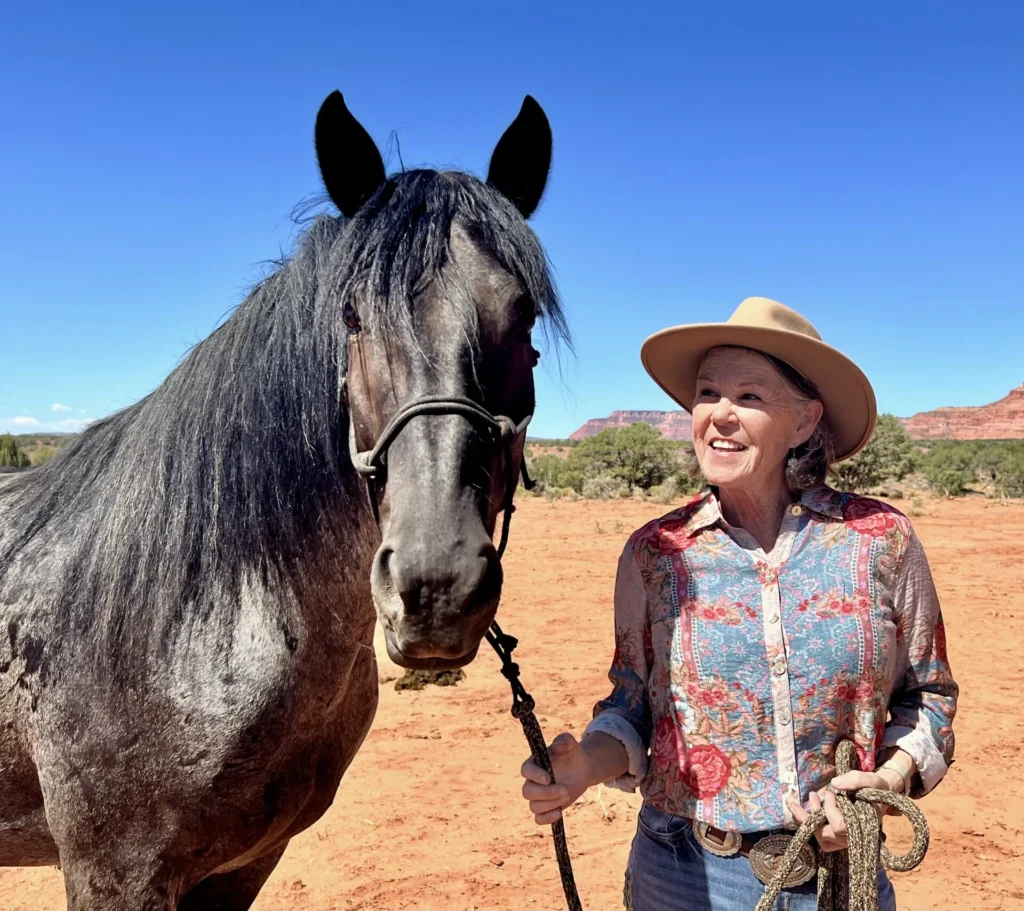
Susana “Sue” Della Maddalena fell in love with horses when she was six years old after reading Black Beauty. Like many children who fall hard for an animal they don’t actually have, she did the next logical thing: She pestered her father into taking her to a horse rental stable every weekend. There, she always rode the same pony, Peanut.
At 11, Sue’s persistence paid off in a much bigger way when she got a horse named Tina for her birthday. The two were inseparable until Sue left for college and had to give Tina up, something that broke her heart. Fortunately, Tina went to a farmer near Sue’s home who wanted a horse for his grandchildren, so Sue was able to visit her for a long time afterward.
But apparently, once a horse person, always a horse person.
When Sue turned 40, she decided she was finally at a place in her life where she could have a horse again. So, she got one. Then one horse became four.
Over the years, several of Sue’s horses have been rescues or have had special needs. She likes being able to give a horse that might be harder to place somewhere else a good home for life.
And I think the horses Sue has chosen to make room for in her life tell us something about her. She sees potential. She sees possibilities. She isn’t put off because an animal may need a little more patience, understanding, or care. Instead, she looks at what that animal needs and what might be possible if someone is willing to provide it.
As it turns out, that’s a pretty good description of how Sue approaches people and ideas, too.
The Instinct to Connect
When I first met Sue, she was executive director of PetSmart Charities. She hired me to write several of the organization’s annual reports and organize conferences, which gave me the opportunity to work with her and her team over the years. I always enjoyed those projects, in part because Sue is one of those people who can quickly see the big picture. You can bring her an idea, and she gets it – not just what you’re trying to accomplish, but where the idea might lead and what it could become.
I was reminded of that when I first told her about Humane Perspectives: Leadership in Animal Welfare. I reached out because I wanted Sue to contribute to the book. With decades of experience that have taken her from leading PetSmart Charities to running community-based animal welfare organizations to her work today as Senior Advisor, Strategic Partnerships for Best Friends Animal Society, I knew she would have something important to say about leadership.
Sue agreed to contribute, but almost immediately, our conversation became about more than her essay. She started suggesting other animal welfare leaders I should consider – people she respected and believed had something valuable to add.
And then she offered to connect me with them.
That’s Sue.
She’s a connector, but not simply because she knows a lot of people. She pays attention to what people do well and seems to instinctively recognize where people, ideas, and opportunities might fit together. When I asked her to be part of the book, she didn’t just think about what she could contribute. She started thinking about who else might make the book stronger.
That generosity extended even further when I asked Sue to serve as a contributing editor for the book. She agreed to read all 45 leadership essays before publication and offer her perspective on the collection as a whole. It was a significant commitment, and I was grateful to have someone with her breadth of experience looking at the book not just chapter by chapter, but as a whole.
Making Room for Good Ideas
Perhaps that’s why the title of Sue’s own essay in the book, “Following Your Gut: Embracing New Ideas That Change Things for Animals,” suits her so well. Without giving away the stories she shares, her essay reflects something I’ve seen in Sue myself: She pays attention to good ideas, recognizes possibilities others might overlook, and understands that the best idea in the room doesn’t necessarily have to come from the leader.
One of the ideas Sue helped put into motion years ago has become so commonplace in our everyday lives that most of us encounter some version of it regularly when we’re out shopping, without giving much thought to where it originated. There’s something wonderful about that. A good idea doesn’t need to remain attached to the person who first had it. Sometimes, its greatest success is that it catches on, spreads, and eventually becomes something we simply expect.
Sue understands that. She doesn’t have to be the person with the idea to recognize its potential. She knows when to listen, when to ask questions, when to encourage someone to keep going, and when to help open a door that might allow an idea to become something bigger.
Maybe that’s what makes Sue such a natural connector. She sees the bigger picture – not just the people or ideas in front of her, but what might be possible when the right people and ideas come together.
It’s not all that different from the six-year-old who fell in love with Black Beauty, the 11-year-old who adored Tina, or the 40-year-old who decided there was room in her life for one horse – and somehow ended up with four.
Sue has always made room for possibilities. And throughout her career, those possibilities have turned into meaningful change for animals.
To me, she is one of those people whose impact can be found not only in what she has done, but in all the things she has helped make possible.